- Blog
How to Choose the Right Degreasing Chemical for Barrel vs. Ultrasonic Fastener Cleaning Lines
- Nilesh Kothari
Every fastener manufacturer knows the frustration: a degreaser that works perfectly on one line leaves oily residue or watermarks on another. The chemical isn’t the problem — the mismatch between chemistry and cleaning method is.
Barrel cleaning and ultrasonic cleaning operate on completely different mechanics. A degreasing chemical built for one can underperform, or even damage components, on the other. For manufacturers sourcing chemicals for the fastener industry, especially those working with stainless steel, getting this match right affects rejection rates, surface finish, and downstream plating quality.
This guide breaks down what actually differs between the two processes and how to select degreasing chemistry accordingly.
Meet Our Team at Fastener Fair India 2026
Looking for the right degreasing chemistry for your barrel or ultrasonic cleaning line? Talk to Elite AquaChem’s technical team in person at Fastener Fair India 2026, July 24–26.
Why the Cleaning Method Changes Chemical Requirements
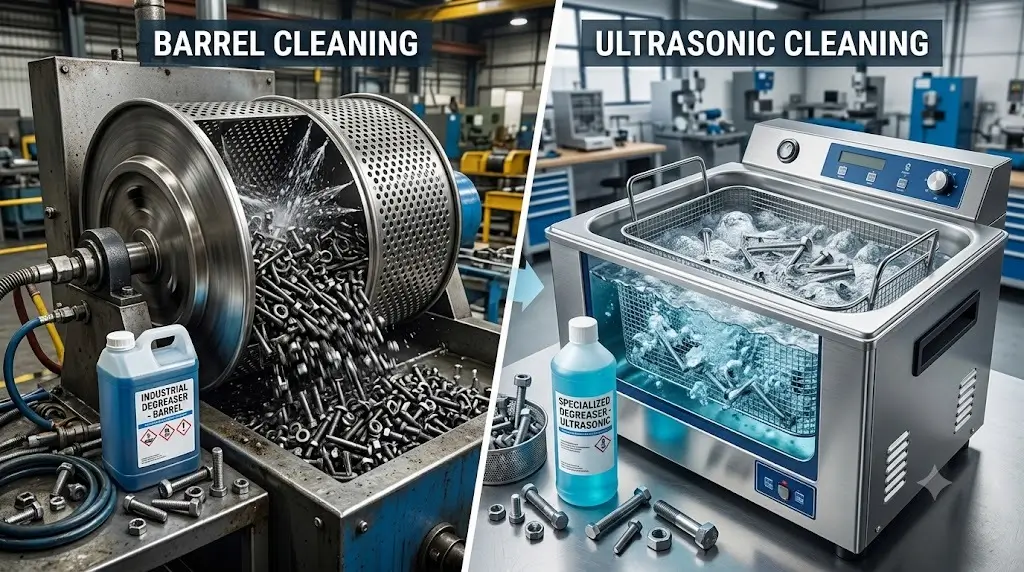
Barrel cleaning relies on tumbling action and bulk immersion. Parts move against each other inside a rotating drum, and the chemical needs time and mild mechanical assistance to break down oils, cutting fluids, and drawing compounds.
Ultrasonic cleaning relies on cavitation. High-frequency sound waves create microscopic bubbles in the cleaning fluid that implode against the part surface, physically dislodging contaminants; including from threads, blind holes, and recesses that barrels can’t reach.
Because the physical cleaning mechanism is different, the chemistry needs different properties:
- Foaming behavior – high foam disrupts cavitation in ultrasonic tanks but is less critical in barrels.
- Viscosity and drag-out – barrel processes tolerate slightly higher viscosity; ultrasonic needs low-viscosity, fast-draining fluids.
- Degreasing speed – ultrasonic systems clean faster due to cavitation, so chemical dwell time and concentration can often be lower.
- Material compatibility – SS fastener manufacturing India lines often run mixed batches (SS, brass, mild steel), and chemical pH needs to suit all substrates without staining or hydrogen embrittlement risk.
Degreasing Chemicals for Barrel Cleaning Lines
Barrel lines typically need chemistry that performs well with mechanical tumbling and longer cycle times.
What to look for:
- Moderate to low foaming, since barrels agitate the solution
- Good emulsification of heavy cutting oils and drawing compounds
- Stability at higher temperatures (60–80°C ranges are common)
- Non-etching formulations for stainless steel to protect surface finish
- Rinse-friendly chemistry to reduce water consumption in multi-stage barrel washers
Typical use cases: Heavy oil removal after cold heading, pre-plating degreasing, and bulk rust-preventive oil removal before packaging.
Not sure which degreasing chemistry fits your line?
Request a free sample for your barrel or ultrasonic cleaning process and test it on your own production batch.
Degreasing Chemicals for Ultrasonic Cleaning Lines
Ultrasonic lines are usually the final precision-cleaning step before plating, passivation, or inspection — so the chemistry needs to support cavitation efficiency, not fight it.
What to look for:
- Low-foam or defoaming additives, since foam absorbs ultrasonic energy and reduces cavitation efficiency
- Fast wetting action to penetrate threads, blind holes, and undercuts
- Compatibility with the ultrasonic frequency and tank material
- Neutral to mildly alkaline pH for stainless steel fasteners to avoid pitting or staining
- Filtration compatibility, since ultrasonic baths are often recirculated and filtered
Typical use cases: Pre-passivation cleaning, final degreasing before electropolishing, and cleaning fasteners with complex geometries like self-tapping or flanged designs.
Struggling with rejections or staining after degreasing?
Talk to our chemists, we’ll help you match the right chemistry to your substrate, contaminant type, and cleaning method.
Key Factors Before You Choose
Beyond the cleaning method itself, a few factors decide which chemical fits your line:
- Substrate – SS 304/316 fasteners need different pH tolerance than carbon steel or brass.
- Contaminant type – cutting oils, drawing lubricants, buffing compounds, and rust preventives all respond differently to alkaline vs. neutral cleaners.
- Downstream process – if plating or passivation follows, residue-free rinsing matters more than raw cleaning speed.
- Effluent treatment – biodegradable, low-VOC formulations reduce ETP load, which matters for compliance-focused Indian fastener manufacturing hubs.
- Cycle time targets – ultrasonic can often run shorter cycles at lower concentration than barrel, affecting overall chemical consumption and cost per batch.
Still unsure which chemistry suits your line? Our team will be discussing barrel vs. ultrasonic degreasing requirements in detail at Fastener Fair India 2026 (July 24–26) – drop by our stall for a free consultation.
Common Mistakes Fastener Manufacturers Make
- Using the same degreaser concentration across both barrel and ultrasonic lines without adjusting for foam and dwell time
- Ignoring foam control in ultrasonic tanks, which silently reduces cavitation efficiency over weeks
- Choosing the cheapest chemical without checking SS compatibility, leading to staining or intergranular attack
- Skipping periodic bath analysis, causing gradual contamination buildup that isn’t visible until rejection rates rise
Conclusion
Choosing a degreasing chemical isn’t just about oil removal — it’s about matching chemistry to the physics of your cleaning line. Barrel and ultrasonic systems each demand different foam behavior, viscosity, and dwell characteristics, and getting this wrong shows up as rejections, staining, or plating defects downstream.
If you’re evaluating degreasing chemistry for your fastener manufacturing line, this is a good time to talk to specialists directly.
Frequently Asked Questions
Some general-purpose degreasers work across both, but performance is rarely optimal. Ultrasonic lines specifically need low-foam formulations, which barrel lines don't require.
SS fasteners are prone to pitting, staining, and hydrogen embrittlement if the degreaser's pH or additive package isn't matched to the grade. Neutral to mild alkaline chemistries are generally safer for SS.
Yes. Foam absorbs ultrasonic energy before it reaches the part surface, reducing cavitation intensity and cleaning consistency.
This depends on contaminant load and throughput, but regular titration or lab analysis helps catch declining bath efficiency before it affects rejection rates.
Many modern biodegradable formulations perform comparably to conventional degreasers while also reducing effluent treatment load; worth evaluating for compliance-focused facilities.
Nilesh Kothari
Founder, Elite AquaChem | 25+ Years in Specialty Metal Treatment Chemicals | Helping Steel Wire, Tube & Fastener Manufacturers Achieve Export-Ready Surface Finishing | ISO 9001:2015 Certified
Recent Post