- Blog
White Rust on Galvanized Steel: Why It Appears After Dispatch and How to Stop It
- Nilesh Kothari
Your consignment left the plant with a clean, bright zinc finish. Three weeks later, the buyer opens the container and sends photographs of a chalky white powder spread across the parts.
The galvanizing was not defective. The zinc thickness will almost certainly pass inspection. But the consignment still gets rejected – and you absorb the freight, the rework, and the damage to a customer relationship you spent years building.
This is white rust, also called wet storage stain. It is one of the most common and most preventable causes of post-dispatch rejection in the galvanizing industry. This guide explains what actually causes it, why freshly galvanized steel is the most vulnerable material in your yard, and the specific process and packing controls that stop it.
What Is White Rust on Galvanized Steel?
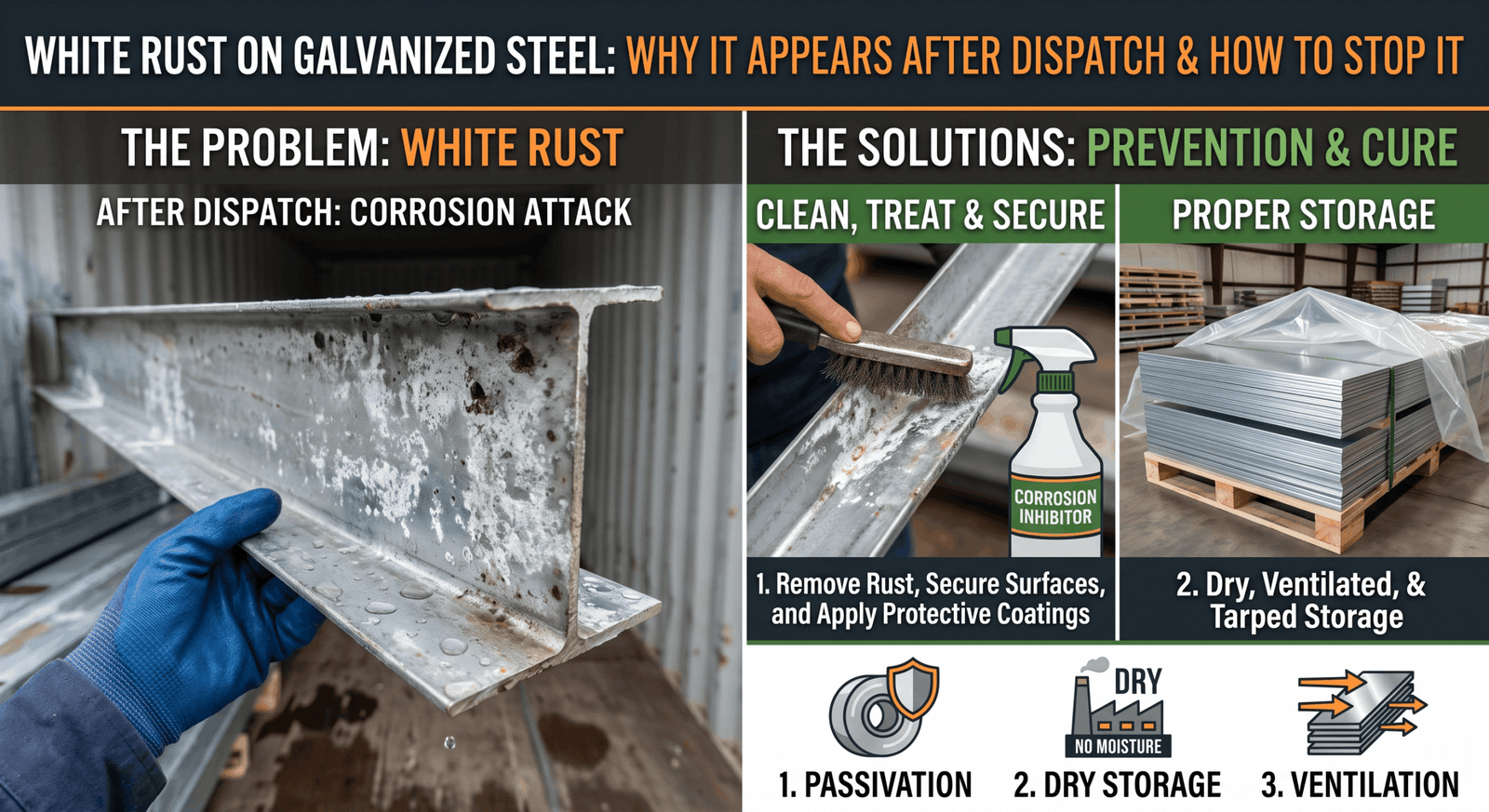
White rust is a bulky, white-to-grey powdery deposit made mainly of zinc hydroxide and zinc oxide, with some basic zinc carbonate. It is not iron rust. No iron is involved at this stage — the corrosion is happening in the zinc layer, not the steel beneath it.
Here is the mechanism in one paragraph.
Galvanized steel does not rely on zinc alone for its long service life. It relies on a thin, stable film of zinc carbonate that forms naturally on the zinc surface when it is exposed to freely circulating air containing carbon dioxide. That carbonate film is the passive layer that gives hot-dip galvanizing its decades of corrosion protection.
When moisture sits on a zinc surface that cannot reach free-flowing air, the carbonate film never gets a chance to form. Instead, the zinc reacts with the trapped water and keeps reacting — producing zinc hydroxide. Because the reaction never stabilises, deposits accumulate rapidly and can look alarming within days.
The American Galvanizers Association, GalvInfo and the Hot Dip Galvanizers Association of Southern Africa all describe the same root condition: moisture plus restricted airflow on an unpassivated zinc surface.
Why It Appears After Dispatch, Not Before
This is the part most plants miss.
Freshly galvanized steel is the most vulnerable steel you will ever handle. The zinc has just come out of the kettle. It has undergone almost no atmospheric oxidation. The protective carbonate patina does not exist yet — it takes weeks of open-air exposure to develop properly.
So the window of maximum risk is exactly the window in which you bundle the parts, strap them tightly, wrap them, and put them inside a sealed steel box for a two-week sea voyage.
Three conditions converge:
- The surface is chemically at its most reactive. No patina, no protection.
- The parts are packed tightly. Nested angles, stacked sheets, bundled tubes and drummed fasteners have almost zero airflow between contact faces.
- Moisture gets trapped and cannot escape. Rain during loading, incomplete drying after quench, humid monsoon air sealed into the packing, or condensation inside the container as it moves between temperature zones.
That last one catches Indian exporters repeatedly. A container loaded in Mumbai in August carries humid air. As it crosses colder waters, the moisture in that trapped air condenses on the coolest surface inside the box — your galvanized parts. Nobody opened the container. Nobody spilled water on it. The water was already inside, in the air, when the doors were sealed.
This is why the problem shows up at the buyer’s end and not in your yard. By the time it becomes visible, the material has been sitting in the worst possible conditions for two to four weeks.
Losing consignments to white rust after dispatch?
The Five Real Causes
1. No passivation after quench
Parts go straight from the kettle to cooling and packing with no conversion coating applied. The zinc has no interim protection during its most vulnerable weeks.
2. Tight stacking with no spacers
Sheets, angles and gratings stacked face-to-face. Capillary action pulls water into the gap between surfaces and holds it there indefinitely.
3. Incomplete drying before packing
Parts packed while still damp from quench or rinse. You are sealing water in with the goods.
4. Condensation inside transit packaging
Humid air sealed inside shrink wrap, VCI-free plastic or a closed container. Plastic wrap without ventilation is often worse than no wrap at all.
5. Exhausted or contaminated passivation bath
Passivation is being applied, but the bath is out of concentration, contaminated with drag-in, or the dip time has crept down as line speed increased.
Cause 5 is the frustrating one, because the plant believes it is protected. The tank exists, the operator is dipping, the paperwork says passivated. But nobody has titrated the bath in six weeks and the working concentration has drifted well below the effective range.
If white rust starts appearing on consignments from a line that was previously clean, check the bath before you check anything else.
How Serious Is It? Grading White Rust Before You Act
Not all white rust is equal, and treating a light stain as a catastrophe wastes money. Grade it before you decide on action.
Light staining
- Appearance: Thin white powder, surface only. Zinc lustre visible underneath when wiped.
- Zinc loss: Minimal
- Structural impact: None
- Action: Wipe or brush clean, then allow open-air exposure so the patina can form. Usually acceptable for service.
Moderate staining
- Appearance: Thicker white deposits, dulled surface, patchy grey areas.
- Zinc loss: Small but measurable
- Structural impact: Negligible if coating thickness still meets specification
- Action: Clean, verify coating thickness against the specification, document the reading, then re-store correctly.
Severe staining
- Appearance: Heavy, bulky white-to-dark deposits. Parts may be stuck together. Black or red staining visible under the deposit.
- Zinc loss: Significant
- Structural impact: Coating may fall below specified thickness
- Action: Remove deposits and measure coating thickness. Re-galvanizing may be required where red rust is present.
Two commercial points matter more than the technical ones:
White rust interferes with paint and powder adhesion. If your part is destined for a duplex system, a white-rust-affected surface will not bond reliably. The coating fails later, in service, at your cost.
Appearance drives rejection more than metallurgy does. A light stain that will do no long-term harm still fails a visual inspection at the buyer’s gate. In export contracts, “fit for purpose” rarely survives an argument with a purchase manager holding a photograph.
The Primary Defence: Passivation After Quench
Storage practice matters. But storage practice is largely out of your hands the moment the truck leaves your gate.
Passivation is the one defence that travels with the part.
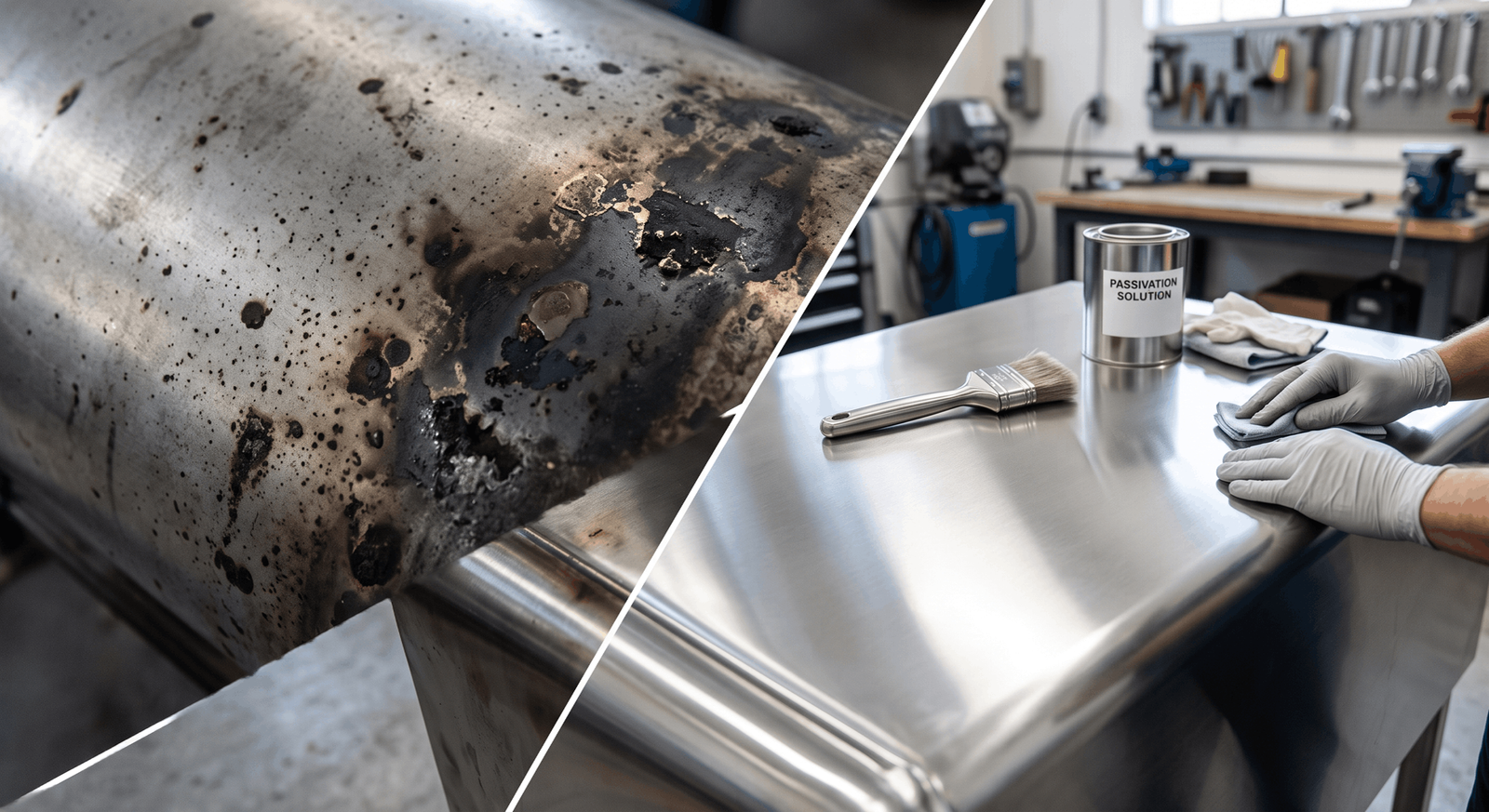
A passivation treatment applied immediately after galvanizing deposits a thin, largely invisible conversion film on the zinc surface. That film acts as a stand-in for the natural carbonate patina during the exact period when the natural patina does not yet exist. It keeps moisture from reacting directly with fresh zinc while the part is in transit and storage.
Chromate-based passivation applied immediately after galvanizing is the long-established method for preventing wet storage stain, and the American Galvanizers Association lists it alongside clear coats and oils as an accepted passivation route.
Where passivation fits in the line:
Kettle → Quench → PASSIVATION DIP → Drain / Dry → Cool → Pack
Two implementation notes decide whether it works:
- Apply it hot, immediately after galvanizing. The passivation reaction is most effective on a freshly withdrawn, still-warm surface. A dip applied hours later, after the part has cooled and started to oxidise unevenly, will not perform the same way.
- Dry thoroughly before packing. Passivation does not license you to pack wet parts. A passivated but damp bundle will still stain.
At Elite AquaChem, our Aquachrome Passi 100 is a trivalent chrome-based passivation chemical formulated for hot-dip galvanized and zinc-plated components, designed to bond to the surface immediately after quenching and form a stable protective layer against white rust and oxidation.
Trivalent vs Hexavalent Chrome: What Export Buyers Now Demand
If you export — particularly into the EU, the UK, or to any OEM supply chain feeding electrical and electronic equipment — this is a commercial issue, not a chemistry issue.
Hexavalent chromium, Cr(VI), is a restricted substance under RoHS. It is classified as carcinogenic and carries significant occupational health and effluent treatment burdens. Galvanizers applying hexavalent passivation to components covered by RoHS have to manage bath concentration carefully to stay under the threshold.
Trivalent chromium, Cr(III), is RoHS-compliant and has become the standard alternative for passivation coatings. It also carries a much lighter effluent treatment load, which matters directly for your ETP running cost and your consent-to-operate conditions.
Hexavalent Cr(VI) — the legacy option
Restricted under RoHS
Classified as carcinogenic
High effluent burden — requires reduction to Cr(III) before precipitation
Offers self-healing behaviour from soluble Cr(VI)
Forgiving of bath drift, low process control demands
Increasingly refused by international buyers
Trivalent Cr(III) — the compliant option
RoHS-compliant
Substantially lower toxicity classification
Lower effluent burden — no reduction step needed
No self-healing property
Requires tighter bath control on concentration, pH and temperature
Broadly accepted in export supply chains
Be aware of the trade-off, because it is real. Trivalent passivates do not have the self-healing behaviour that soluble hexavalent chromium provides, and trivalent baths are generally less forgiving of drift and contamination. Trivalent passivates are also commonly operated warm rather than at ambient temperature.
The practical conclusion: switching to trivalent is the right commercial move, but it raises the importance of bath control discipline. A poorly controlled trivalent bath will underperform a well-controlled hexavalent one — which is why some plants that switched reported worse white rust and wrongly blamed the chemistry.
Still passivating with hexavalent chrome?
Get a free switchover review for your line — bath requirements, effluent load and running cost, mapped against your current process.
Passivation Bath Control Points
Most passivation failures are process control failures, not product failures. Build these into your shift checklist.
Check every shift
Working concentration — titrate against your supplier’s method. Concentration drops with drag-out, and below the effective range the film forms incompletely.
Bath pH — measure and correct to the TDS range. Trivalent chemistry is pH-sensitive and drift degrades film quality.
Bath temperature — confirm against the TDS operating window. Trivalent passivates typically need controlled warmth to react properly.
Dip time — verify against actual line speed, not the SOP. Line speed creeps up under production pressure and contact time silently falls.
Check daily
Drag-in from quench — water carryover progressively dilutes the tank and mimics chemical failure.
Drying before packing — the best passivation film will not survive packed-in moisture.
Check weekly
Zinc and iron contamination — dissolved zinc from the substrate accumulates in the bath and destabilises trivalent chemistry.
Do not run these ranges from memory or from a competitor’s datasheet. Take concentration, pH, temperature and dip time directly from the technical data sheet of the product you are actually using, because operating windows differ meaningfully between formulations.
Storage and Transport Checklist
Passivation buys you protection. Correct handling makes that protection sufficient.
In the yard
Store galvanized material off the ground, on racks or dunnage — never directly on soil or concrete
Angle stacks so water drains off rather than pools
Insert spacers between stacked items so air circulates over every zinc surface
Avoid nesting parts face-to-face where capillary action can hold water
Keep new stock out of the rain during its first weeks, when it is most vulnerable
Do not stack freshly galvanized parts tightly on top of one another
For packing and dispatch
Confirm parts are completely dry before any wrapping goes on
Avoid sealed plastic wrap without ventilation — it traps humid air against the surface
Use VCI paper or VCI film for long sea voyages where practical
Add desiccant to containers on long or multi-climate routes
Load in dry weather where possible; never load wet material into a container
Ensure crates and bundles permit some air movement between parts
Before the container doors close, ask one question: is there any liquid water, or any humid trapped air, going into this box with the goods? If yes, you are shipping the cause along with the product.
How to Remove White Rust That Has Already Formed
If a consignment has already stained, act by grade.
Light deposits. Brush with a stiff nylon brush and rinse with clean water. Dry thoroughly. Then expose the material to freely circulating air so the natural carbonate patina can finally form. In many cases this restores an acceptable appearance and the material remains fit for service. An Australian industry review of the 2007 American Galvanizers Association evaluation of removal methods found white vinegar to be effective and environmentally benign for removing white rust deposits, applied with a nylon brush and rinsed off with clean water.
Moderate deposits. Clean as above, then measure the remaining coating thickness against the governing specification before releasing the material. Document the reading. If it passes, the consignment is defensible.
Severe deposits with black or red staining underneath. Zinc loss is significant and the steel may be exposed. Remove all corrosion products, measure coating thickness, and assess against specification. Where red rust is present and the coating has fallen below spec, re-galvanizing is the correct answer, not a touch-up.
One caution on remediation chemistry. Aggressive acids will strip zinc along with the deposit and turn a cosmetic problem into a structural one. If you are treating a large consignment, work from a controlled formulation and a tested procedure rather than an improvised acid wash.
And treat every occurrence as a process signal. White rust on a dispatched consignment means either the passivation stage failed or the packing practice failed. Cleaning the parts without finding which one will simply produce the same complaint on the next shipment.
Not sure if your passivation is actually working?
Request a free sample of Aquachrome Passi 100 and test it on your own galvanizing line before you commit to anything.
The Bottom Line
White rust is not a galvanizing failure. It is a gap between the kettle and the customer – the weeks in which fresh zinc has no natural patina and your material is sealed inside packaging with trapped moisture.
Close that gap with three things:
- Passivate immediately after quench, using a trivalent chrome formulation that meets your buyers’ compliance requirements
- Control the passivation bath with a shift-level checklist rather than an annual assumption
- Dry, space and ventilate every consignment before it is packed
Do these consistently and post-dispatch white rust complaints largely disappear.
Frequently Asked Questions
No. Ordinary rust is iron oxide and indicates the steel itself is corroding. White rust is zinc hydroxide and zinc oxide — it forms in the zinc coating, and in light and moderate cases the steel underneath is untouched and still fully protected.
Usually not. White rust is a storage and handling condition, not a galvanizing defect. A correctly galvanized part with the right coating thickness will still develop white rust if it is packed damp, stacked tightly and shipped without passivation. Coating thickness measurement will normally confirm the galvanizing itself is within specification.
Passivation is the strongest single measure and the only one that protects the part after it leaves your control, but it is not a licence to pack wet or stack tightly. The reliable result comes from passivation plus correct drying, spacing and ventilated packing. Proper storage of galvanized steel remains necessary even when passivation agents are used.
Transit duration and climate variation. Domestic loads are usually delivered within days in a stable climate. Export consignments spend weeks sealed inside containers that cross temperature zones, which creates repeated condensation cycles on parts that have not yet developed their protective patina.
For most exporters, yes. Hexavalent chromium is restricted under RoHS and increasingly refused by international buyers, while trivalent chromium is compliant and reduces your effluent treatment burden. Plan the switch alongside tighter bath control, since trivalent chemistry is less forgiving of concentration and pH drift.
Yes, and significantly. White rust deposits interfere with coating adhesion. If a part is going into a duplex paint or powder system, the affected surface must be properly cleaned and prepared first, or the coating will fail in service.
Nilesh Kothari
Founder, Elite AquaChem | 25+ Years in Specialty Metal Treatment Chemicals | Helping Steel Wire, Tube & Fastener Manufacturers Achieve Export-Ready Surface Finishing | ISO 9001:2015 Certified
Recent Post